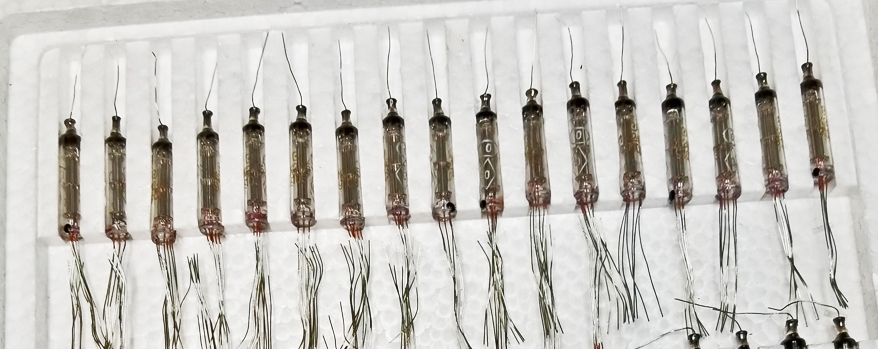
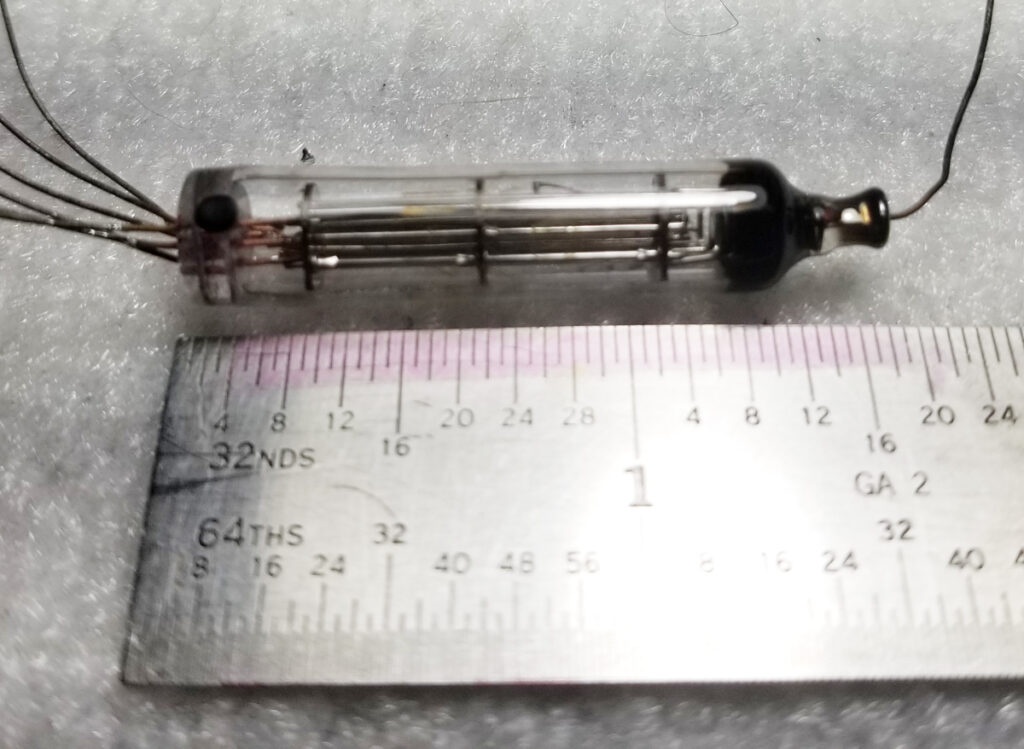
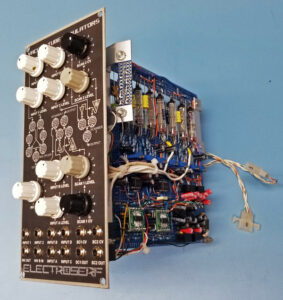
During the cold war and up until the 1990s the Soviet Union manufactured large quantities of “rod” tubes, miniature vacuum tubes that use rod-shaped electrodes in place of standard grids and anodes. These tubes were primarily used in telecommunication equipment in fighter jets as the western world moved on to solid-state technology.
These tubes are now readily available on the surplus market and due to their compact size and low power requirements are easily adapted to audio and synthesizer design.
Originally the only synthesizer circuit available for these tubes was Ken Stone’s Catgirl Synth VCA pcb. For many years nobody paid much attention to these tubes, and they stayed relatively obscure. More recently a few derivative VCA designs appeared in the market.
In 2017 Electroserf decided to begin investigating the possibilities for musical designs and started research. The goal was to see if these parts could be used as the basis for other kinds of synthesizer modules, such as VCOs, filters, and waveshapers.
Here are the results.
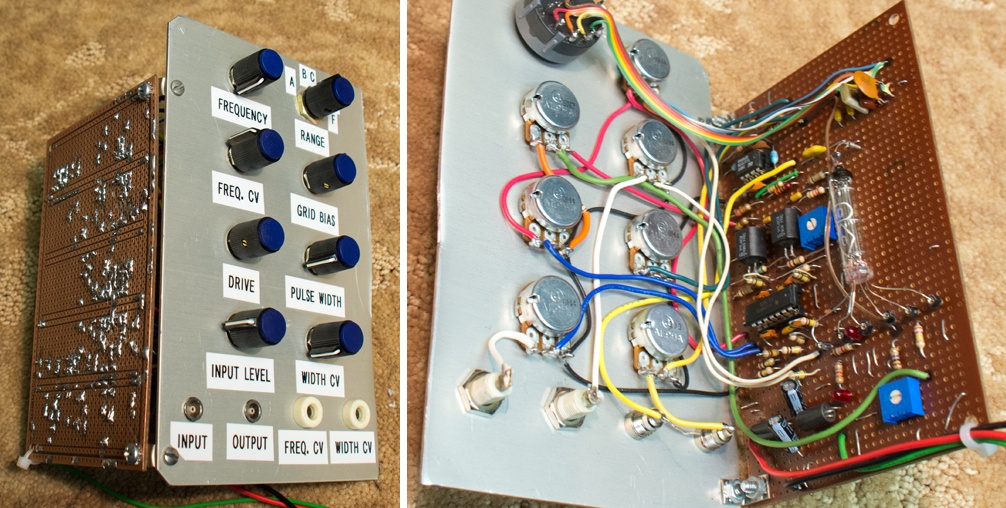
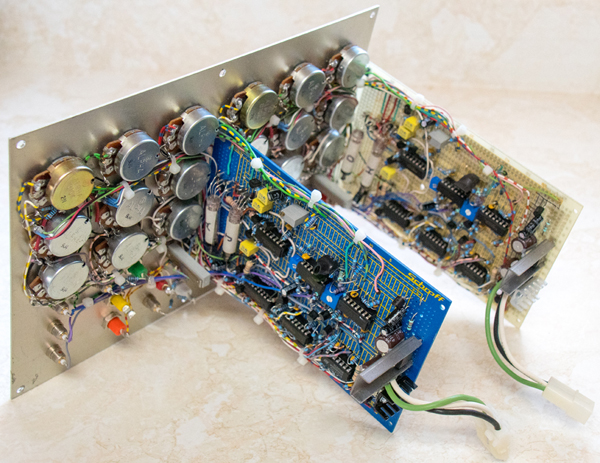
The first module to be developed was a basic single tube oscillator with CV control over various tube parameters, called the MiG Modulator. External signals could be injected into the circuit, and it was a fun module that still works exactly as it did when first built. Unfortunately it’s only capable of very rough distorted sounds and doesn’t track volt/octave.
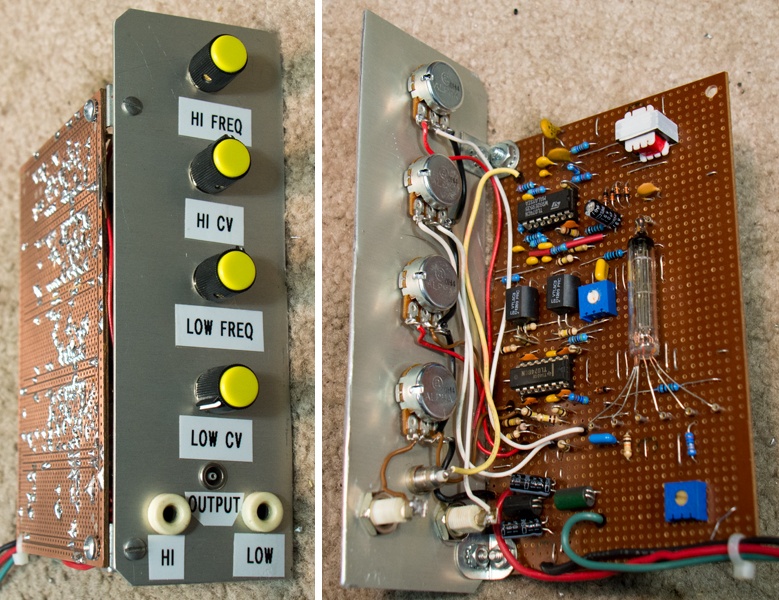
After noticing that with some settings the MiG Modulator produced interesting noise, research began into how to make a rod tube as noisy as possible. The result was the first generation MiG Thruster, with just two CV parameters and, like the previous module, using vactrols.
The vactrols were soon eliminated from the design however, as parts variability and availability were less than optimal.
This prototype, with the vactrols now replaced, is also still functioning as new after many years of use.
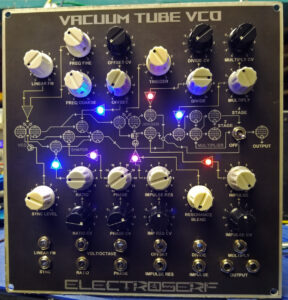
The next step was developing a volt/octave VCO. The obscure and unconventional multivibrator type circuit was utilized for the oscillator core, resulting in a full, rich and completely new VCO sound. Novel wave-shaping was also possible with this circuit topology.
The VCO was followed by VCF, wavefolder, sub-octave, and VCA modules, as well as an updated Thruster with new features.
Below is a demonstration video for some of the module prototypes from that generation.
In collaboration with Catalyst Audio, five of these designs were then ported into Eurorack modules and released as retail products.
Here’s a video demonstration of the new Thruster:
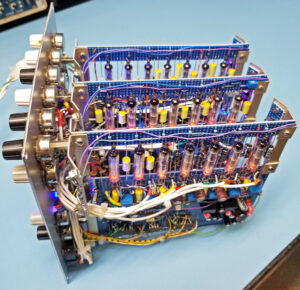
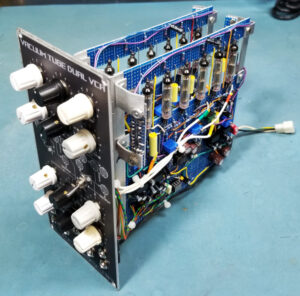
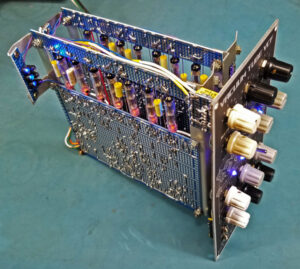
The next stage in the evolution of the MiG modules was the elimination of all semiconductors from the audio signal processing stages, creating the Electroserf all-tube audio path synthesizer.
A whole new prototyping rack was designed and constructed and all new modules were designed and built for the project.
Here is a video showing the construction of the new prototyping rack and the modules.
And another demonstrating some of the module features:
Finally the case is complete! Two complex VCOs (including waveshaping, suboctave, wavefolding, PWM, and impulse resonance), one noise generator, one VCF, a dual VCA, a 4 quadrant multiplier, and a pan-and-scan module make a nice mix.
And here is a video showing the complete construction from start to finish of the second VCO. The soundtrack is composed only from sounds created with the all-tube audio path prototype, including the panning effects.
Working with rod tubes has been a very fun and productive endeavour so far, with a wonderful new and unique electronic instrument created that produces amazing sounds. Only the future knows what exciting new developments are coming next, so stay tuned!